
The Shift from Competency to Capability-Driven Talent Strategy
Strategic Report: The Shift from Competency to Capability-Driven Talent Strategy
Subject: Future-Proofing Talent: Will Capability Frameworks Replace Competency-Based Models?
For: Chief Executive Officers, CHROs, and Organizational Development Leaders
Prepared by: Aldrin Q. Gaduena
Date: March 10, 2026
Executive Summary
The rapid integration of AI and a volatile business environment have rendered traditional, static competency-based talent frameworks insufficient. While excellent for standardization and compliance, competencies are inherently backward-looking and task specific. This report advocates for the adoption of Capability Development Frameworks, which focus on holistic skill clusters, agility, and forward-looking strategic alignment. This shift is not merely a change in HR terminology; it is a vital competitive advantage.
Introduction: The AI Catalyst and the Work Redesign Mandate
The 2024-2025 Global Talent Trends report emphasizes that the primary barrier to growth is the human element: the urgent need for employees who can adapt, learn with agility, and remain resilient. Organizations are moving from "AI adoption" (implementing the tool) to "Work Redesign" (reimagining the work itself).
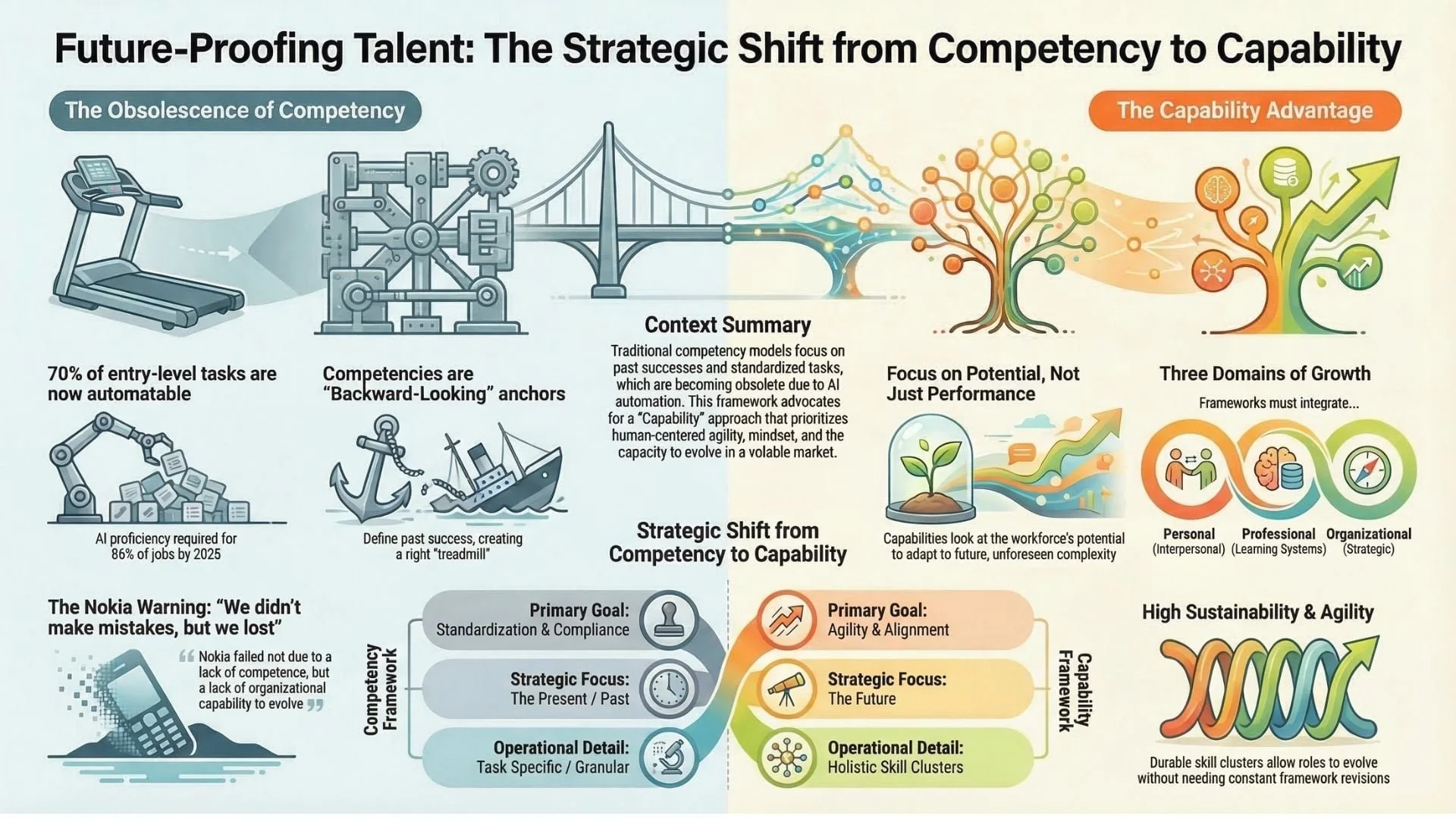
This redesign forces a difficult question for leadership and talent: What is the human-specific value proposition? While data indicates that 70% of entry-level tasks are automatable and 86% of jobs will require some form of AI proficiency starting 2026, the unique answer lies in human-centered skills (complex emotional intelligence, creativity, and adaptability) and the pace at which the workforce can respond to structural change.
The Limitation of Competencies in a VUCA World
Historically, Competency-Based Frameworks were the cornerstone of talent management. Their strengths—precision, clarity, and measurability—are also their weaknesses today. In a Volatile, Uncertain, Complex, and Ambiguous (VUCA) environment, these frameworks fall short for three critical reasons:
They are Backward-Looking: They define what success was for past business needs, not what is required for the future.
They are Too Rigid: They standardize specific behaviors and tasks. This is highly effective when stability is guaranteed but fails during "black swan" events (like the pandemic). Organizations whose workforces knew only one way to do their job struggled to adapt to remote/hybrid structures overnight.
High-Maintenance Obsolescence: The lifespan of specific technical skills is shrinking rapidly. Frameworks focused on specific tools must be completely updated every 1–2 years, becoming a resource-intensive "treadmill" for HR.
The Rise of Capability Development: Agility as a Strategy
The Association for Talent Development (ATD) addressed these shortcomings with the Capability Development Framework. This model is strategically designed to foster long-term growth and organizational agility.
While a competency looks at the minimum standard required for current performance, a capability looks at the potential of the workforce to adapt to future complexity. The standard ATD model, based on research with 3,000 L&D practitioners, defines three key domains:
Personal Capability: Essential interpersonal skills (trust, resilience, cultural agility) that underpin an adaptable culture.
Professional Capability: The expertise to design the learning systems and processes that maximize individual performance.
Organizational Capability: The strategic abilities needed to ensure talent development is the primary engine driving operational results.
Strategic Comparison: Competing vs. Capable
| Strategic Feature | Competency Framework | Capability Framework |
|---|---|---|
| Primary Goal |
Standardization & Compliance (Minimize Risk) |
Agility & Alignment (Maximize Opportunity) |
| Strategic Focus | The Present/Past: Focus on skills that have already proven success. | The Future: Focus on mindsets and behaviors required for anticipated needs. |
| Operational Detail | Task-Specific: Highly granular definitions of required behaviors. | Holistic Clusters: Flexible groups of skills, knowledge, and mindset. |
| Sustainability | Low: Needs constant revision as tools, platforms, and roles change. | High: Durable and sustainable, allowing roles to evolve around the capability. |
Overcoming the Implementation Gap: An Executive Guide
To successfully bridge the implementation gap, executives must treat the transition to a capability model as a strategic evolution rather than a simple HR update. While the framework is still maturing toward a global proof-of-concept, leaders can overcome its inherent "abstract nature" by integrating clear proficiency scales that define what excellence and progression look like without the stifling rigidity of old models. This clarity must be supported by a profound cultural shift, led from the top, that pivots the organization from a "check-the-box" compliance mindset toward a culture of self-directed learning focused on real-world problem-solving and outcomes. Finally, to address the challenge of measuring ROI on these more holistic traits, organizations should leverage AI-driven people analytics. By using AI to track qualitative shifts in performance language and employee sentiment—measuring indicators like agility and proactive problem-solving—leaders can finally correlate long-term growth with tangible, quantitative performance gains.
Conclusion: Evolve or Irrelevance
The most potent example of this structural paralysis is Nokia. As competitors capitalized on smartphone disruption, Nokia—which was excellent at its defined competencies—failed. The CEO’s famous observation, "We didn’t make any mistakes, but somehow we lost," is a warning.
Nokia didn't fail at their competencies; they failed at organizational capability—specifically, the capacity to evolve. In the current landscape, the most effective competitive strategy is to ensure your talent can not only withstand chaos but capitalize on it.
