
The Organization Doctor
Dr. Abegial Tongco, PhD
When we are not feeling well, our first instinct is often simple: we rest, drink water, or reach for over-the-counter medication. But when symptoms persist, we consult a medical professional. A doctor does not immediately prescribe treatment based on guesswork. Instead, we are asked to undergo laboratory exams e.g. blood tests, urinalysis, X-rays anything necessary to understand what is truly happening beneath the surface. Only after a proper diagnosis do we receive a treatment plan designed to restore our health.
Organizations are not very different.
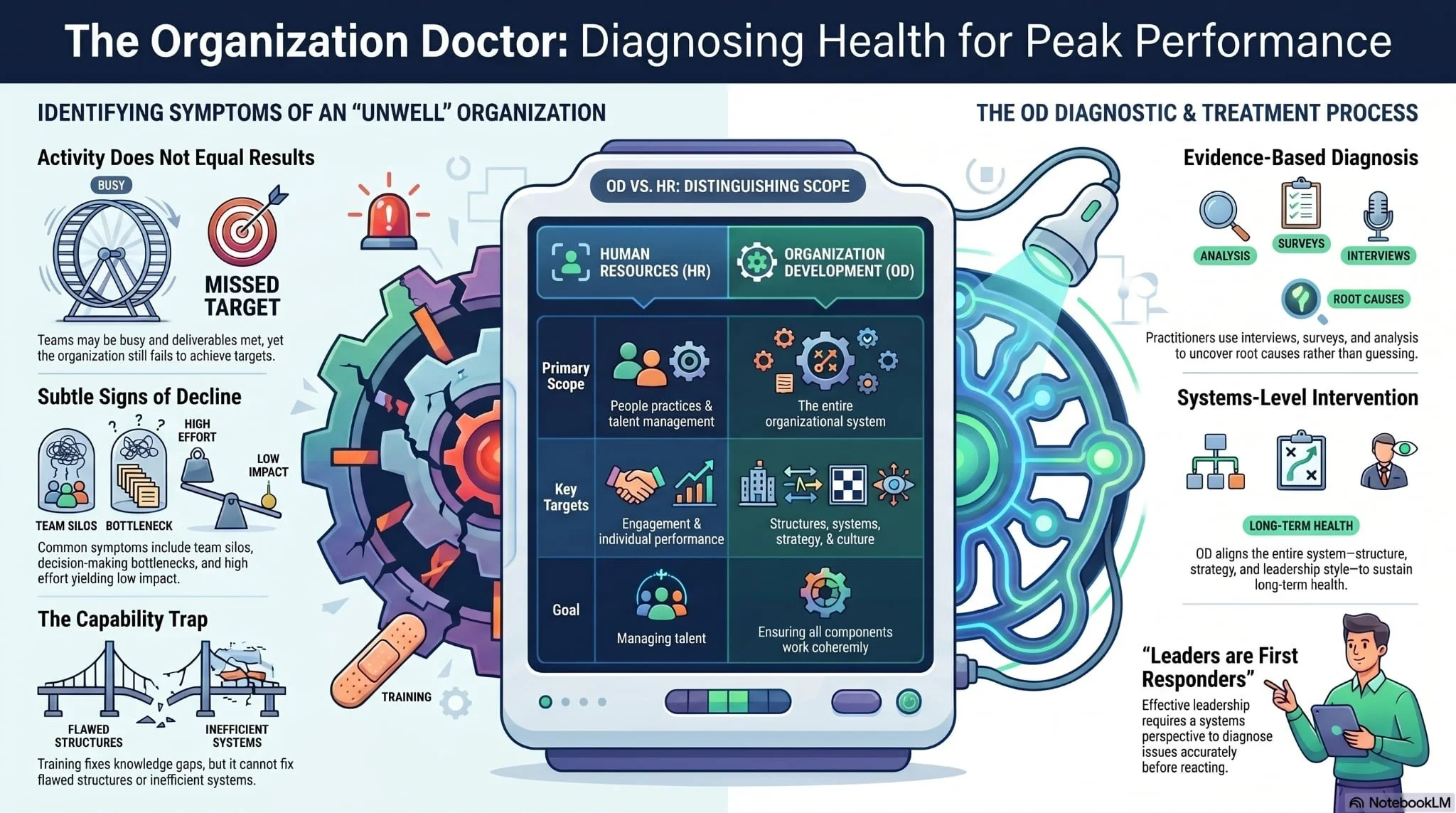
There are moments when, on paper, everything seems to be working. Teams are busy. Deliverables are being completed. Meetings are happening. Yet, despite all this activity, targets are not being achieved. Performance lags behind expectations. Energy is high yet results are not.
This is often the first sign that the organization is unwell.
Organizational illness rarely announces itself loudly. It shows up subtly:
Teams working in silos despite shared goals
Misalignment between strategy and execution
Decision-making bottlenecks
High effort but low impact
In many cases, the organization has a clearly articulated vision, mission, and values. Corporate goals are well-defined. But somewhere along the way, alignment is lost. The structure no longer supports the strategy. Systems fail to enable efficiency. Leadership styles may unintentionally hinder collaboration.
The result? Organizational health begins to decline.
This is where Organization Development (OD) steps in. The discipline acts as the organization doctor.
Much like a physician, an OD practitioner does not jump straight into solutions. The work begins with diagnosis.
Data collection: through interviews, surveys, focus group discussions
Analysis: identifying patterns, gaps, and inconsistencies
Root cause identification: going beyond symptoms to uncover underlying issues
From here, priorities are set. Not everything can be addressed at once, just as not all symptoms require the same urgency in medicine. Strategic interventions are then designed, sequenced, and implemented over time.
The goal is not just to “fix” what is broken but to restore and sustain organizational health.
The Common Misconceptions About OD
Despite its critical role, Organization Development is often misunderstood.
“OD is just training and development.”
Training is indeed one of the most powerful interventions, especially when the issue is a lack of knowledge or skills. However, not all organizational problems are competency-related.
No amount of training can fix:
A flawed organizational structure
Inefficient systems and processes
Misaligned performance metrics
Cultural barriers to collaboration
Training addresses capability. OD addresses the entire system.
“OD is the same as HR.”
This confusion is understandable. People are at the heart of every organization, and HR plays a vital role in managing talent, engagement, and performance.
However, OD operates on a broader canvas.
While HR focuses on people practices, OD looks at:
Structures: how work is organized
Systems: how processes enable or hinder performance
Strategy: how direction is set and executed
Style: how leadership shapes behavior and culture
Technology: how tools support productivity
In this sense, OD does not replace HR, it strengthens it. It provides the systems thinking necessary to ensure that all organizational components work together coherently.
Why the Organization Doctor Matters
At its core, Organization Development is about understanding how inputs are transformed into outputs through value-adding activities.
It asks critical questions:
Where are we losing value?
What is preventing us from achieving our goals?
Are our systems enabling or constraining performance?
Is our structure aligned with our strategy?
These are not quick-fix questions. They require discipline, data, and deep analysis.
And this is precisely why OD is essential not just for OD practitioners, but for leaders.
A Discipline for Leaders
Leaders are, in many ways, the first responders to organizational symptoms. The ability to diagnose issues accurately, rather than reacting to surface-level problems, is what separates reactive management from strategic leadership.
Organization Development equips leaders with:
A systems perspective
The discipline of root cause analysis
The ability to design sustainable, long-term solutions
Because in the end, organizational health is not maintained by isolated efforts. It is sustained by alignment.
Just as we would not rely solely on pain relievers to treat a serious medical condition, organizations cannot rely on isolated interventions to address systemic challenges.
They need diagnosis.
They need alignment.
They need intentional, evidence-based treatment.
They need an organization doctor.
And perhaps more importantly, they need leaders who think like one.
